
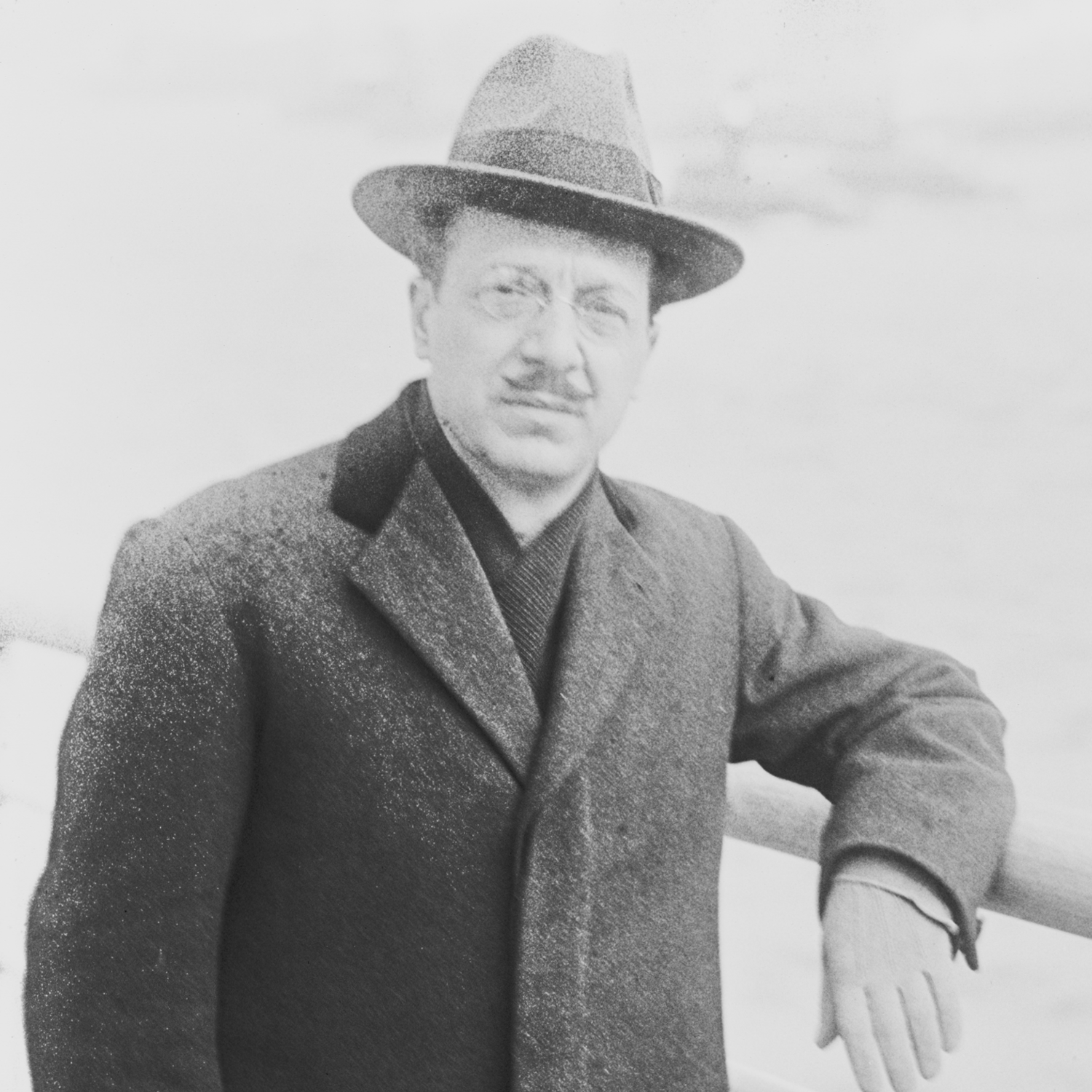
Leonard Bernstein
American composer Leonard Bernstein (1918–1990) both changed and embodied his country’s understanding of what passion about music can be. Born in Lawrence, Massachusetts to shtetl immigrants from the Ukraine, Leonard Bernstein displayed his musical talent very early. He listened omnivorously to any and all music in any and all genres; long before he reached adolescence, he could outshine his local piano teacher. At Harvard, joining apparently limitless flamboyant energy with prodigious discipline, Bernstein surrounded himself with scholarly and intellectual excellence, with deep, exuberant friendships and with endless creative inspiration. Bernstein studied composition with Walter Piston (1894–1976) and wrote his senior thesis on the identification, recurrence and significance of African American elements in classical music. In his junior year, Bernstein met Aaron Copland (1900–1990) who became a life-long friend. Older conductors Dmitri Mitropoulos (1896–1960) and Serge Koussevitzky (1874–1951) became both mentors and friends.
When he was twenty-four, Bernstein moved to New York City. Here, his career began a meteoric rise to professional and popular esteem and fame. He rose to national notice when he stepped in to conduct a stupendous concert of the New York Philharmonic, replacing the ill Bruno Walter (1876–1962). His first symphony, Jeremiah, won enthusiastic praise from critics and the public alike in 1942. Two years later, Bernstein’s first Broadway musical, On the Town, was an immediate hit. By the end of World War II, Bernstein was one of the best-known artists in the United States, and the life-long pattern of intense activity and accomplishment in complementary and sometimes competing musical endeavors was set.
Benjamin Britten
Benjamin Britten was born on St. Cecilia's Day, November 22, 1913. He considered that day to have a special significance for him - that, because Saint Cecilia was the patron saint of music, he then owed it to himself to compose his music in her honor, as a tribute to her inspiration. The Hymn to St. Cecilia was composed by Britten during his return voyage to England in March, 1942, when he and Peter Pears sailed home from Canada after a six-months' wait there for passage; A Ceremony of Carols was also written on this trip .
Throughout his life, Britten was strongly influenced by the sea. He was born within the sound of it - on the stormy North Sea coast of East Anglia; while on Long Island he was near it; and he returned to the same wild, turbulent, bleak land/seascape of his early years, to die within the sound of it. The winds and the waves permeate his music: Aphrodite rose from the sea in the St. Cecilia; the sea predominates in Noye's Fludde, Death in Venice, Peter Grimes, Billy Budd, and others. It is indeed appropriate that the Aldeburgh Festival and its affiliates, the Britten-Pears School for Advanced Musical Studies and the Britten-Pears Library, are close to the sea he loved so well.
His colleague, Peter Pears, was on the faculty of the School, and continued to further Britten's legacy of a vision for the advanced training of string players and the voice. Their fruitful artistic partnership testified to their influence upon each other, particularly as seen in the succession of Britten's lovely canticles and song cycles. Pears was his foremost interpreter. They shared a love of language, of poetry, of music itself that was stimulated by the skills of others, both vocal and instrumental. Britten's talent was inspired by the association of his colleagues, whose artistic co-operation enabled him to maintain his purity of vision and avoidance of egotism.
Britten's sacred works may be divided into five groups: carols and anthems, which in-clude many Christmas pieces, some set to folksongs and old carols: liturgical music of five items only, including Psalm 150; four cantatas, of which the best known are the Hymn to St. Cecilia and Rejoice in the Lamb, followed by St. Nicolas and Cantata Misericordium, a tale of the Good Samaritan; the sacred songs, of which five Canticles are the most import-ant, some on themes of scripture. The three Church Parables, Curlew River, the Burning Fiery Furnace, and The Prodigal Son, are the summit of Britten's sacred music, a trinity of parables of outstanding power. He also composed the miracle play, Nave's Fludde, com-bining words and music from many sources.
Benjamin Britten's religious convictions prompted him to plan many of his compositions within the framework of the Church of England, according to the occasion; his overriding desire was that his music should be a means of communication with his fellow human beings. He was more than musician, composer, conductor, pianist, educator-he was a great humanitarian also. His own words should speak for him, on receiving the First Aspen Award: "I offer to my fellow men music which may inspire them or comfort them, which may touch them or entertain them, even educate them-directly and with intention. . . it is the composer's duty, as a member of society, to speak to or for his fellow human beings."
