
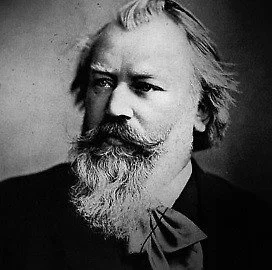
Johannes Brahms
source: Biography.com
Johannes Brahms (1833-1897)
Brahms was a German composer, pianist, and conductor of the mid-Romantic period. His music features expressive counterpoint, freer dissonance, rhythmic vitality, and traditional forms. His works include four symphonies, four concertos, a Requiem, much chamber music, and hundreds of folk-song arrangements and Lieder (German art songs). (Wikipedia)
Few masterpieces speak to the heart as directly as Brahms's Ein Deutsches Requiem (A German Requiem). Nominally a Lutheran, but generally considered not religious, Brahms chose his own biblical texts from Martin Luther's German translation of Scripture, rather than the traditional Latin Mass, creating a work whose purpose is not to pray for the dead, but to comfort the living.
Most of the "German Requiem" was written when Brahms was still a fairly young man. When his beloved mentor Robert Schurnann died in 1866 Brahms began work on the Requiem. Brahms left the project, had some of it performed, put it aside, and then returned to it several times over a period lasting more than a decade. But ultimately, the Requiem is a fully mature work. The impetus for its ultimate completion was his beloved mother's death in February of 1865.
The opening words, "Blessed are they that mourn," set the tone for everything that follows. Rather than dwelling on judgment or fear, Brahms explores grief with remarkable tenderness, leading listeners toward hope, peace, and quiet reassurance.
Across its seven movements, the Requiem traces a journey from mourning to consolation. Powerful choruses alternate with moments of quiet reflection, nowhere more beautifully than in the fifth movement, where the soprano offers words of comfort that many hear as Brahms's tribute to his mother.
Completed in 1868, Ein Deutsches Requiem established Brahms as one of Europe's greatest composers and has remained a cornerstone of the choral repertoire ever since. Its enduring power lies in its universality. Whatever one's faith or background, the music speaks eloquently of loss, compassion, and the resilience of the human spirit.